
User Research – Methods and Best Practices
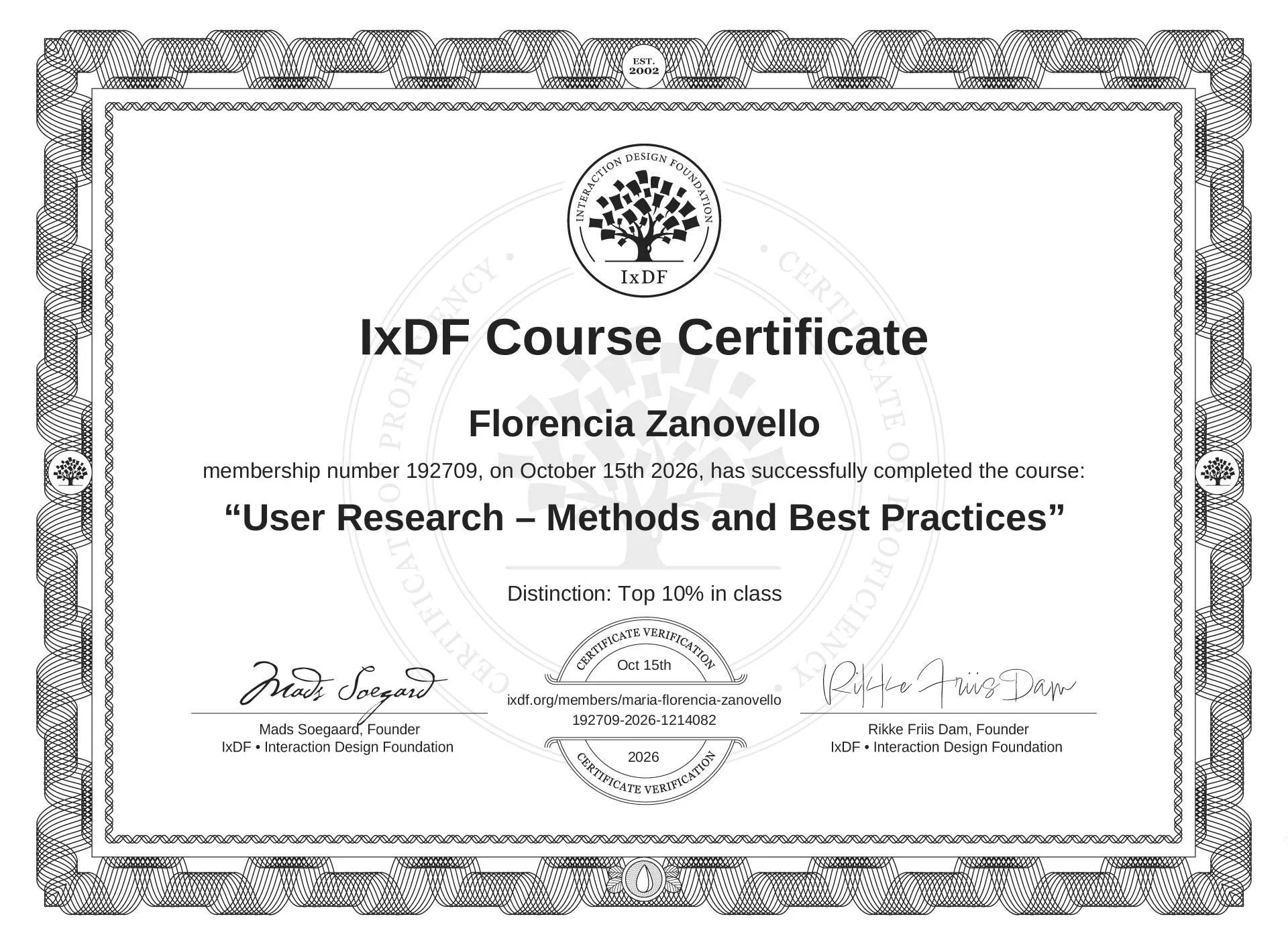
Verified Competencies Demonstrated by Florencia Zanovello
By completing this curriculum to the standards of the IxDF Educational Codex, Florencia Zanovello has demonstrated mastery of how to:
Plan, conduct, and analyze semi-structured qualitative interviews.
Ask productive interview questions using Kvale and Brinkmann's nine question types, build rapport with participants, and use the critical incidents technique to prevent vague, generalized answers.
Conduct thematic analysis of qualitative data for both deductive and exploratory studies, and recognize and counter common pitfalls.
Plan, moderate, and report on usability tests using the think-aloud protocol, and apply the right testing approach and metrics for design decisions.
Plan, run, and analyze a contextual inquiry using its four principles: context, partnership, interpretation, and focus.
Plan and conduct observational studies (active or passive).
Create engaging personas grounded in research data that communicate user needs and foster empathy within design teams.
Use affinity diagrams, empathy maps, and user journey maps to synthesize qualitative data and communicate results for maximum stakeholder impact.
Run design-thinking workshops that turn research insights into actionable design opportunities.
Map stakeholders across business, engineering, and UX using Tomer Sharon's framework and conduct stakeholder interviews to surface constraints, history, and expectations, in order to gain support for research.
Make the case for user research by articulating its three core purposes (relevance, usability, and ROI) and turning them into arguments that secure resources.
Choose the right qualitative research method for the question at hand, understand when to combine methods, and know how qualitative research complements quantitative approaches.
Keep qualitative research trustworthy through grounded theory coding and Kvale's three lenses for objectivity.
Apply user research ethics, including informed consent, participant data safety, safeguards for vulnerable populations, and respect for participants' right to withdraw at any time.
Write a comprehensive user research project plan, pilot it before recruiting participants, and document the full study.
