
AI for Designers: IxDF Course Certificate
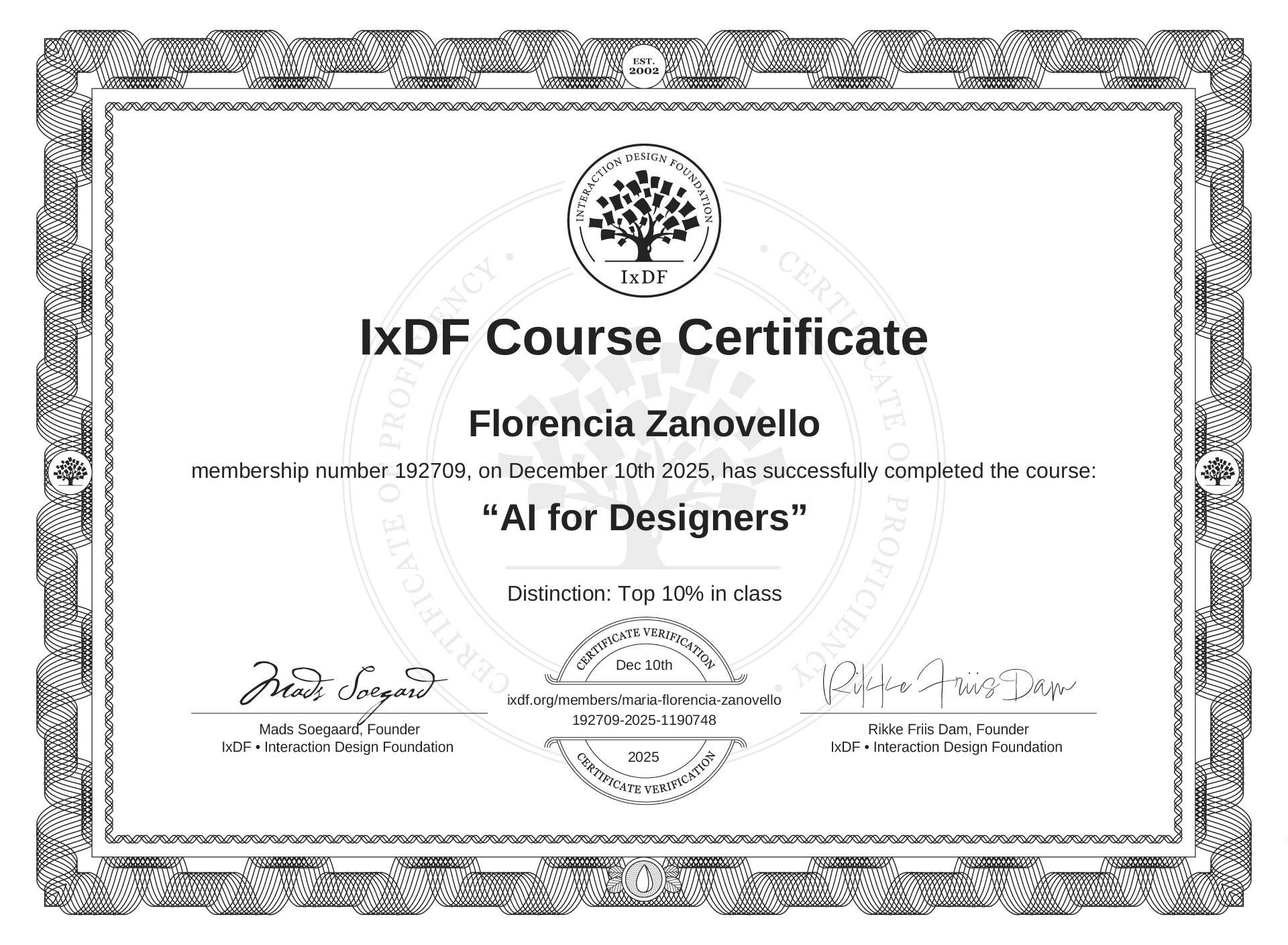
Verified Competencies Demonstrated by Florencia Zanovello
By completing this curriculum to the standards of the IxDF Educational Codex, Florencia Zanovello has demonstrated mastery of how to:
Design AI-powered experiences responsibly by setting accurate user expectations, increasing system transparency, and accounting for privacy, safety, and ethical risks.
Apply the National Institute of Standards and Technology's (NIST) seven characteristics of a trustworthy AI system (valid and reliable, safe, secure and resilient, accountable and transparent, explainable and interpretable, privacy-enhanced, and fair with harmful bias managed) to evaluate and strengthen AI product decisions.
Automate repetitive design tasks with AI and make deliberate decisions about what to automate and what to keep human-led to protect quality, intent, and user outcomes.
Write AI-assisted problem statements and apply the AI workflow framework across the design thinking process and delivery.
Generate and iterate on high-fidelity UI directions with AI, then apply human judgment to refine them, including AI-assisted UX copy, microcopy, and content variations that fit the product voice.
Produce multiple wireframe options with AI and apply the generate, test, and refine loop to ground layout decisions in early user feedback.
Use AI to process and synthesize research data, cleaning inputs, extracting themes, and turning raw notes and transcripts into structured insights the team can act on.
Apply Microsoft's HAX interaction guidelines to design AI products that are transparent, trustworthy, and user-controllable.
Interpret AI-generated heatmaps, clarity metrics, and heuristic audits to catch usability issues before recruiting for live testing.
Conduct market research and competitive analysis with AI, then validate findings against real user data.
Build and interact with synthetic AI personas and research-backed interactive personas to pressure-test ideas and surface usability issues before formal testing.
Use an adapted version of the Google PAIR framework, including Wizard-of-Oz prototyping and a confusion matrix, to design responsibly with machine learning.
Produce launch-ready supporting assets with AI, from marketing copy and app icons to pitch deck content, that communicate a product's value clearly and efficiently.
Frame AI prompts using zero-shot, one-shot, few-shot, role, and chain-of-thought techniques to get precise, usable outputs across text, image, and task-based models.
